1. Where do the remittance rules come from?
The rules are governed entirely by the Foreign Exchange Management Act (FEMA) 1999. FEMA dictates exactly how, where, and how much money the Indian diaspora can move out of India.
Whether you are sending money to support family, reinvesting in global markets, or liquidating Indian inheritance, compliance is mandatory. Understanding these rules is the difference between a seamless bank transfer and a multi-month compliance headache.
NRI vs NRO
2. The Two-Lane System: NRE vs. NRO
To move money out of India, you must first understand the legal tax location of your funds.
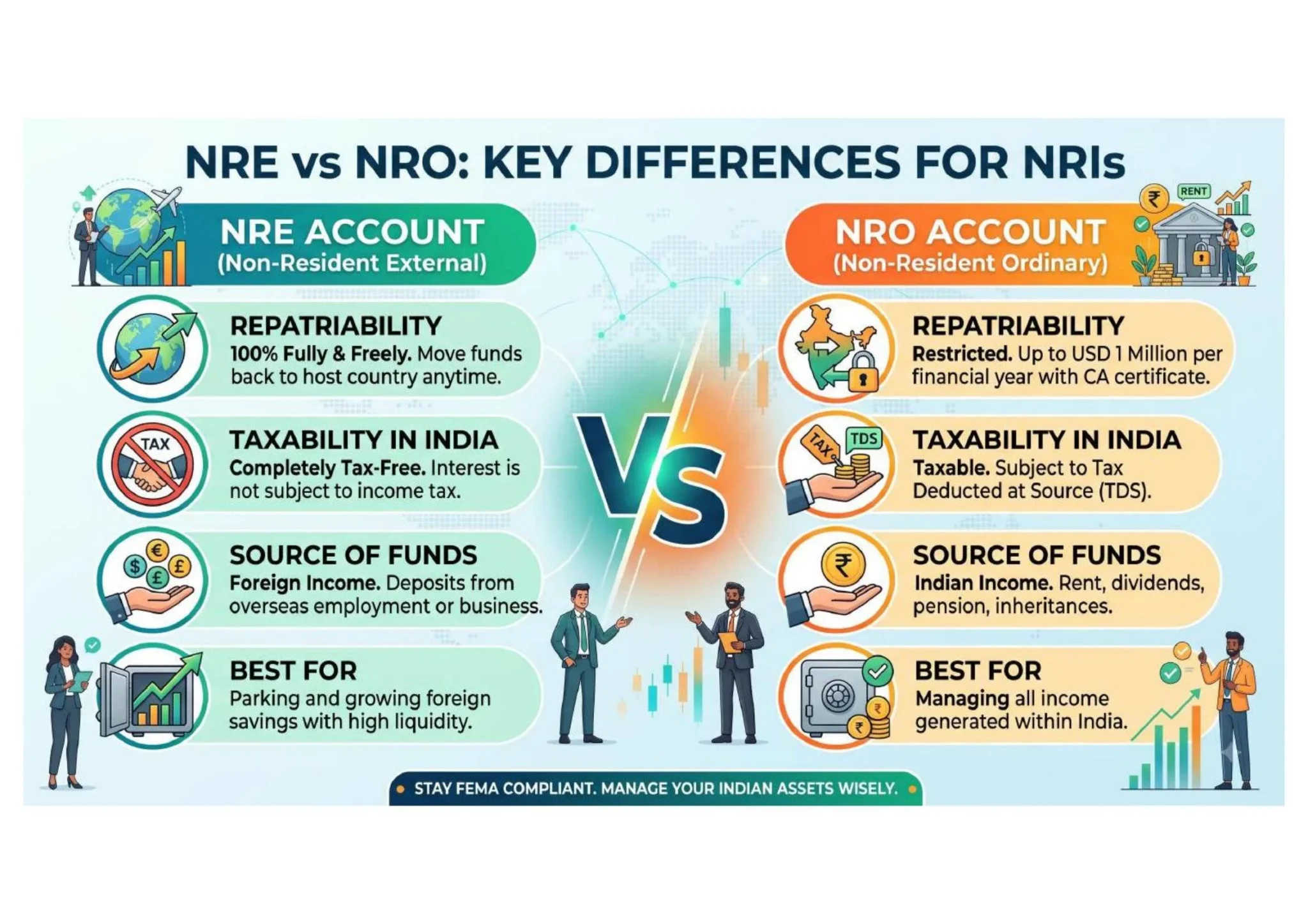
The Express Lane (NRE Accounts): Funds held in your Non-Resident External (NRE) account are considered technically outside India. Because this money was originally earned abroad and remitted to India, you can move it back to your foreign bank account at any time. There are no regulatory caps, limits, or clearance requirements for NRE transfers.
The Regulated Lane (NRO Accounts): Your Non-Resident Ordinary (NRO) account holds money earned within India (like rent, dividends, or local asset sales). Remittances from this account are strictly regulated, capped per financial year, and require mandatory tax certification before your bank can hit send.
3. Liquidating Assets: The $1 Million Scheme
FEMA provides a specific annual window for NRIs and OCIs to move their accumulated Indian wealth abroad. You are permitted to remit up to USD 1 million per financial year from your NRO account balances or asset sale proceeds.
This million-dollar limit covers:
- Sale proceeds of personal investments and real estate
- Inherited property or assets received through a deed of settlement
- Capital balances left behind when you originally migrated from India
Current Income Exception: While rent, dividends, and pensions are technically current income, you can credit them directly to your NRE account to make them freely repatriable. However, a Chartered Accountant must first certify that all applicable Indian taxes have been paid.
4. The Real Estate Nuance
Real estate is often the largest asset an NRI holds in India, but the rules for sending that money abroad depend entirely on how you originally bought the property.
Foreign Funded: Suppose you purchased a residential apartment using foreign exchange via an NRE or FCNR account. You can repatriate the original purchase cost freely without utilizing your USD 1 million annual limit. Note that this specific foreign-funding exemption is legally restricted to a maximum of two residential properties.
Indian Funded or Inherited: Suppose you bought a property using local Rupee funds, an Indian home loan, or you inherited it from a resident relative. The entire sale proceeds must be remitted under the USD 1 million scheme. You cannot bypass the cap for locally acquired property.
5. Compliance: The 15CA & 15CB Mandatory Duo
You cannot send money abroad from your NRO account without proof of tax payment. The Income Tax Clearance process involves two critical documents that function together.
Form 145 : This is your personal undertaking, filled out and submitted online via the e-filing portal, detailing the nature and destination of the remittance.
Form 146 : This is a mandatory certificate issued and signed by a Chartered Accountant. The CA verifies the nature of the income, checks for Double Taxation Avoidance Agreement (DTAA) benefits, and certifies that the correct Tax Deducted at Source (TDS) has been withheld.
Pro Tip: Every Form 146 must feature a valid Unique Document Identification Number (UDIN) generated by the CA, or the remitting bank will reject the transaction.
6. Special Provisions for Students
If you are an Indian student studying abroad, you are legally treated as an NRI for remittance purposes under FEMA. You have two main channels to receive funds from home.
Maintenance Remittances: You can receive up to USD 100,000 per year from close relatives in India for your standard living expenses based on a simple self-declaration.
Educational Remittances: There is no upper regulatory limit on funds sent abroad to cover your tuition fees and university dues, provided you present the official demand letter or invoice from your university.
Personal Assets: Like any other NRI, student visa holders can also remit up to USD 1 million per year from their own Indian bank accounts or local asset liquidations.
7. Strategy for a Smooth Transfer
To avoid transaction delays, treat your NRO account like a waiting room for immigration. Before you initiate a large transfer, verify that your PAN is active, your bank KYC is updated to non-resident status, and your forms 15CA/15CB are ready.
For large property sales, consider applying for a Lower Deduction Certificate from the tax department well in advance. This prevents excess TDS (which can be as high as 20-30% on capital gains) from being locked up in a lengthy income tax refund cycle.
on’t panic if your bank requests extensive documentation for a cross-border transfer. Due to stringent AML and FEMA regulations, rigorous checks are completely normal.
The essential rule is to ensure your compliance paperwork is bulletproof:
- Verify that your NRO and NRE accounts are cleanly designated with your current foreign address.
- Ensure every dollar of local Indian income has been mapped to its appropriate tax payment before attempting to remit.
- Keep a clear paper trail of your original property acquisition costs and bank funding routes so you can confidently answer any bank or regulatory query later.
Disclaimer: FEMA regulations are subject to frequent updates and circulars by the Reserve Bank of India.This insight is for general educational purposes only and does not constitute tax, legal, FEMA or regulatory advice. Specific professional advice should be obtained before taking any action specifically catering to your situation.
“I help founders, NRIs, and corporates turn complex financial laws into strategic clarity—where compliance becomes confidence, and litigation becomes leverage.”
Lekshmi N, CA Tweet